


 If you're shopping for P100 filters for a 3M reusable respirator, three model numbers appear again and again:
At first glance, the choice can be confusing.
All three are P100 filters.
All three attach to compatible 3M reusable respirators using the familiar bayonet connection.
All three can be used for certain oil and non-oil particulate hazards.
And all three provide at least 99.97 percent particulate filtration efficiency under applicable NIOSH testing.
So why does 3M make three different versions?
Because filtration efficiency is only part of the story.
The 2091 is the straightforward general-purpose P100.
The 2097 adds a carbon layer for nuisance-level organic vapor relief.
The 7093 encloses the filter media inside a hard plastic case that provides additional physical protection in demanding work environments.
Depending on what you're doing, one of those differences may matter a lot more than the identical P100 rating printed on all three.
Let's compare them.
If you're still learning how reusable filters and cartridges work, start with our Complete Guide to 3M Reusable Respirators and 3M Respirator Filters & Cartridges Explained.
3M 2091 vs. 2097 vs. 7093: The Quick Answer
| Feature | 3M 2091 | 3M 2097 | 3M 7093 |
|---|---|---|---|
| Filter Rating | P100 | P100 | P100 |
| Minimum Filtration Efficiency | 99.97% | 99.97% | 99.97% |
| Oil Resistance | Strongly resistant to oil | Strongly resistant to oil | Strongly resistant to oil |
| Nuisance Organic Vapor Relief | No | Yes | No |
| Construction | Flexible pancake style | Flexible pancake style with carbon layer | Hard-case filter |
| Connection | 3M bayonet | 3M bayonet | 3M bayonet |
| Best Reason to Choose | Simple, versatile P100 filtration | P100 plus relief from certain nuisance organic vapor odors | P100 filtration in a protected hard housing |
If you want the shortest possible answer:
Choose the 2091 when you simply need a versatile P100 particulate filter.
Choose the 2097 when you need P100 particulate filtration and would benefit from nuisance-level organic vapor odor relief.
Choose the 7093 when you want P100 particulate filtration in a more physically protected hard-case design.
The actual respirator selection must still be based on the hazard, concentration, workplace conditions, required protection factor, and applicable approval.
What Does P100 Mean?
Before comparing the physical differences, it helps to understand what all three filters have in common.
P100 is a NIOSH particulate filter classification.
The “P” indicates that the filter is strongly resistant to oil aerosols.
The “100” classification means the filter provides at least 99.97 percent filtration efficiency against the applicable NIOSH test aerosol.
That is higher minimum particulate filtration efficiency than an N95 or P95.
For comparison:
- N95 — at least 95% filtration; not resistant to oil
- P95 — at least 95% filtration; strongly resistant to oil
- P100 — at least 99.97% filtration; strongly resistant to oil
Our N95 vs. P95 vs. P100 guide explains those classifications in greater detail.
But don't make the mistake of interpreting P100 as “protects against everything.”
P100 refers to particulate filtration.
A P100 filter by itself does not automatically protect against hazardous gases or vapors.
3M 2091 P100: The General-Purpose Choice
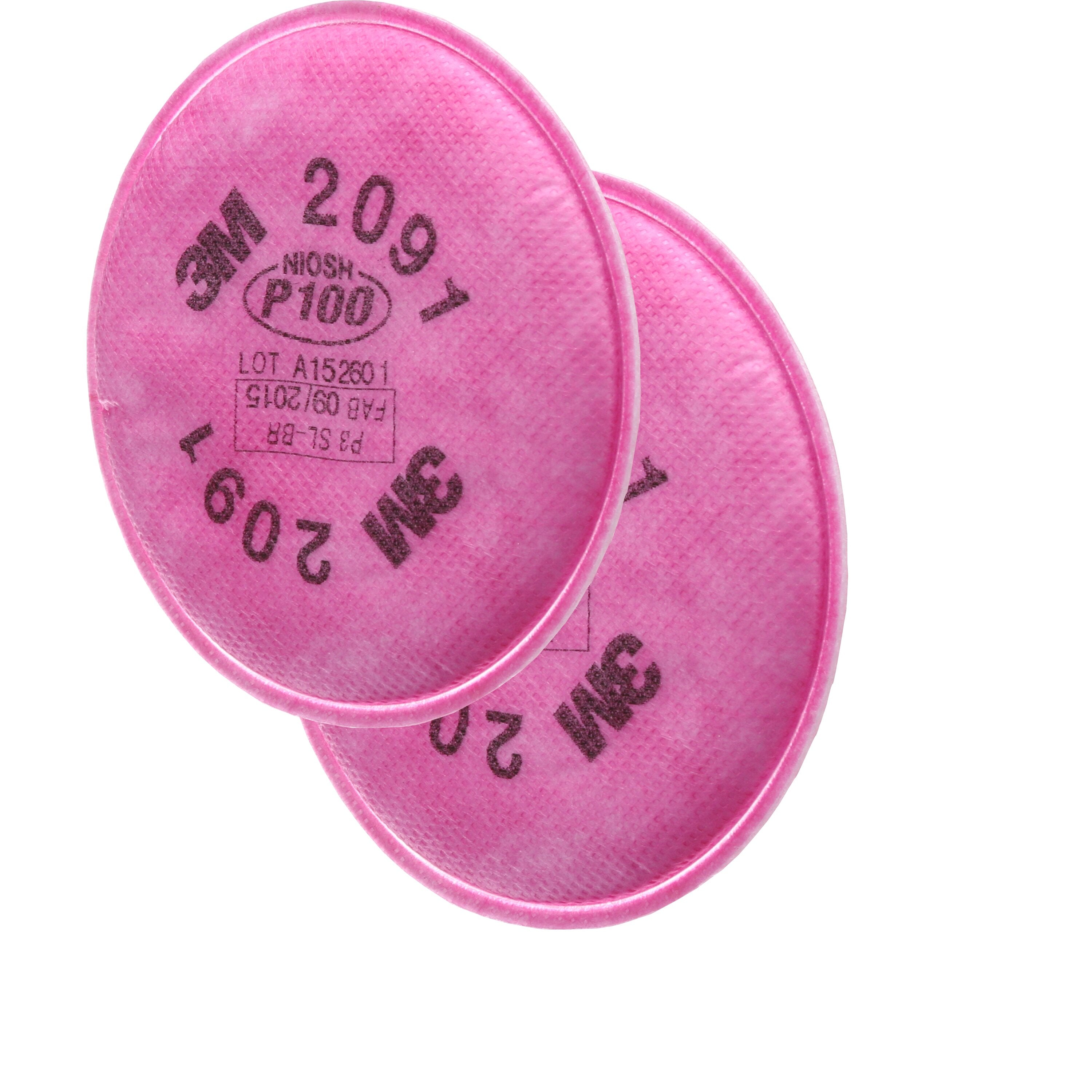
The 2091 is probably the best-known P100 filter in the 3M reusable-respirator lineup.
It is the classic pink pancake-style filter commonly seen on 3M half-mask and full-face reusable respirators.
The 2091 provides P100 protection against certain oil and non-oil particles.
3M identifies applications including professional mold removal, sanding or scraping lead-based paint, woodworking, and working with fiberglass insulation.
Depending on the exposure assessment and complete respirator configuration, P100 filters can also be encountered in applications involving:
- Grinding
- Sanding
- Concrete and masonry dust
- Wood dust
- Fiberglass
- Metalworking
- Certain welding fumes
- Lead-related particulate work
- Mold-remediation particulate exposure
- Other high-efficiency particulate applications
The appeal of the 2091 is its simplicity.
There is no nuisance organic-vapor carbon layer and no hard plastic shell.
It is simply a lightweight, flexible, high-efficiency P100 particulate filter.
Who Should Consider the 2091?
The 2091 makes the most sense when:
- Your hazard is particulate rather than gas/vapor.
- You need P100 filtration.
- You don't need nuisance organic vapor odor relief.
- You don't specifically need a hard-case design.
- You want a straightforward general-purpose P100 filter.
For a lot of users, this is the default P100.
3M 2097 P100: P100 Plus Nuisance Organic Vapor Relief

The 2097 looks very similar to the 2091.
That makes it easy to assume they're essentially interchangeable.
There is one important difference.
The 2097 adds a carbon layer designed to provide nuisance-level organic vapor relief.
That can help reduce odors from certain solvents, degreasers, resins, and other organic vapors when those vapors are present below applicable occupational exposure limits.
This makes the 2097 attractive in environments where the primary hazard is still particulate but unpleasant organic odors are also present at nuisance levels.
Examples may include certain:
- Grinding operations
- Painting preparation
- Solvent-adjacent work
- Resin work
- Maintenance operations
- Industrial environments where nuisance solvent odors are present
The Important Limitation of the 2097
This point is important enough to emphasize.
The 2097 is not a substitute for an organic vapor cartridge when hazardous organic-vapor protection is required.
The nuisance-level organic vapor feature applies to concentrations below applicable occupational exposure limits.
If you're working with a hazardous organic vapor at a concentration requiring respiratory protection, a product such as the 3M 6001 Organic Vapor Cartridge or an appropriate combination cartridge may be required depending on the contaminant and exposure.
Our 3M Filters & Cartridges Guide explains that distinction in detail.
Who Should Consider the 2097?
Choose the 2097 over the 2091 when:
- You still primarily need P100 particulate filtration.
- Nuisance organic vapor odors are present.
- Those vapors are below applicable occupational exposure limits.
- You want odor relief without moving to a larger gas/vapor cartridge configuration.
When hazardous vapor concentrations require respiratory protection, move beyond the 2097 and select the appropriate cartridge system.
3M 7093 P100: The Hard-Case Option

The 7093 looks completely different from the 2091 and 2097.
Instead of exposed flexible filter media, the filtration media is protected by a hard plastic case.
Inside, it is still a P100 particulate filter.
3M rates the 7093 for at least 99.97 percent filtration efficiency against certain solid and liquid aerosols, including oil-based particles.
3M identifies applications including professional mold removal, sanding and scraping lead-based paints, woodworking, and fiberglass insulation work.
The major distinction is physical construction.
The hard housing helps protect the filter media from:
- Physical contact
- Handling
- Some sparks or debris encountered around demanding work environments
- Accidental bumps against equipment or work surfaces
- General jobsite abuse that might more easily contact exposed filter media
That can make the 7093 especially attractive for industrial work, demolition, maintenance, metalworking, construction, and other jobs where the filter is more likely to bump into things.
Who Should Consider the 7093?
The 7093 makes sense when:
- You need P100 particulate filtration.
- You prefer a physically protected filter.
- You work in a demanding industrial or construction environment.
- Your respirator may regularly contact equipment or surrounding surfaces.
- You prefer a compact hard-case filter format.
The hard case does not increase the P100 filtration rating compared with the 2091 or 2097.
It changes the filter's physical design and durability characteristics.
2091 vs. 2097 vs. 7093: Complete Comparison
| Feature | 2091 | 2097 | 7093 |
|---|---|---|---|
| NIOSH Rating | P100 | P100 | P100 |
| Minimum Particulate Efficiency | 99.97% | 99.97% | 99.97% |
| Oil Aerosols | Yes, within applicable limitations | Yes, within applicable limitations | Yes, within applicable limitations |
| Organic Vapor Cartridge | No | No | No |
| Nuisance Organic Vapor Relief | No | Yes | No |
| Carbon Layer | No | Yes | No nuisance-organic-vapor feature |
| Physical Design | Flexible pancake | Flexible pancake | Hard case |
| Connection | Bayonet | Bayonet | Bayonet |
| General Strength | Simple, versatile particulate filtration | Particulate filtration plus nuisance odor relief | Physical protection of filter media |
Does the 7093 Filter Better Than the 2091?
No—not in terms of its P100 classification.
The 2091, 2097 and 7093 all carry the same P100 filtration rating.
Each provides at least 99.97 percent filtration efficiency against the applicable test aerosol when used as part of an approved respirator configuration.
The 7093's hard case does not turn it into a P100-plus rating.
The distinction is physical protection and form factor.
Likewise, the 2097's nuisance organic-vapor feature does not increase its particulate filtration efficiency beyond P100.
This is why comparing these products strictly by “which filters more?” misses the point.
2091 vs. 2097: What's the Real Difference?
If you're choosing between the 2091 and 2097, the decision is relatively simple.
Both are P100.
Both use the flexible pancake-style design.
Both attach to compatible 3M bayonet facepieces.
The key difference is that the 2097 adds nuisance-level organic vapor relief.
If you don't need that feature, the 2091 is the straightforward choice.
If nuisance solvent or resin odors are part of the work environment, the 2097 may be more appealing.
Just remember that nuisance relief means exactly that.
It does not replace a cartridge where organic vapor concentrations require respiratory protection.
2091 vs. 7093: Flexible Filter or Hard Case?
The 2091 and 7093 provide the same P100 classification but package the filtration media very differently.
The 2091 uses exposed flexible filter media.
The 7093 places the filter inside a hard plastic housing.
For light shop work, woodworking, sanding or similar applications, the flexibility and simplicity of the 2091 may be ideal.
For construction, industrial maintenance, demolition or environments where your respirator routinely bumps into equipment, the 7093's housing may make more sense.
Think of the 7093 as giving the P100 filter a protective shell—not a higher filtration rating.
Which P100 Filter for Different Jobs?
 Woodworking
For appropriate wood-dust exposures where P100 filtration is selected, the 2091 is a logical straightforward choice.
The 2097 may make sense where nuisance-level organic vapor odors from nearby materials are present, provided hazardous vapor protection is not required.
The 7093 can be attractive in a production environment where filters receive more physical abuse.
For a broader discussion, read our Best Respirator for Woodworking guide.
Fiberglass Insulation
3M specifically identifies both the 2091 and 7093 for applications involving fiberglass insulation.
Either may provide P100 particulate filtration when appropriately selected.
The choice comes down primarily to physical design and working conditions.
See our Best Respirator for Fiberglass Insulation guide.
Concrete and Silica Dust
P100 filters are commonly considered for high-efficiency particulate filtration, but silica respiratory protection cannot be selected by filter rating alone.
OSHA requirements, exposure levels, engineering controls, task, and required protection factor need to be evaluated.
See our Best Respirator for Silica Dust guide.
Grinding and Metalworking
The 2091 provides a simple P100 option for appropriate particulate hazards.
The 7093 may be particularly attractive where sparks, debris and physical contact make exposed flexible filter media less desirable.
The material being ground still matters. Paints, coatings, metals and oils can introduce hazards beyond basic particulate filtration.
Welding
P100 filters can be used for certain welding-fume applications when appropriately selected.
However, welding can also generate gases and other contaminants.
A P100 filter alone should not automatically be assumed to address the entire welding exposure.
Read our Best Respirator for Welding guide.
Lead Paint Removal
3M specifically lists both the 2091 and 7093 for professional work involving sanding or scraping lead-based paints.
Lead work is subject to specific regulatory requirements, so respirator selection should be part of a complete compliant exposure-control program.
Mold Remediation
3M also identifies the 2091 and 7093 for professional mold-removal applications.
The extent of the remediation and other contaminants present should still be evaluated before selecting PPE.
Painting and Solvents
This is where the 2097 causes confusion.
The 2097's nuisance organic-vapor relief can help with certain odors below applicable occupational exposure limits.
It is not the filter you choose simply because you're spray painting with hazardous solvents.
When organic vapors require respiratory protection, an appropriate cartridge such as the 6001 or an approved combination cartridge/filter may be needed.
Which Respirators Fit the 2091, 2097 and 7093?
 All three use 3M's traditional bayonet-style connection and are compatible with a range of approved 3M reusable facepieces.
Common compatible families include:
- 3M 6000 Series — Small
- 3M 6000 Series — Medium
- 3M 6000 Series — Large
- 3M 6500QL Series — Small
- 3M 6500QL Series — Medium
- 3M 6500QL Series — Large
- 3M 7500 Series — Small
- 3M 7500 Series — Medium
- 3M 7500 Series — Large
3M also approves these filters for additional compatible full-face and other respirator platforms depending on the specific product.
Always verify the complete facepiece/filter combination against current manufacturer and NIOSH approval information.
And don't confuse the bayonet system with 3M Secure Click. Secure Click respirators use a different connection system and their own filters and cartridges.
Does the Filter Change the Respirator's Fit?
The filter does not eliminate the need for a proper face seal.
A reusable respirator equipped with P100 filters is still a tight-fitting respirator.
When required for occupational use, applicable OSHA requirements include medical evaluation, fit testing, training, and user seal checks.
Read our OSHA Respiratory Protection Requirements Guide for more information.
How Long Do 2091, 2097 and 7093 Filters Last?
There is no universal answer such as “one week” or “40 hours.”
Particulate filter life varies depending on:
- Particle concentration
- Type of particulate
- Filter loading
- Breathing rate
- Work intensity
- Oil aerosols
- Contamination
- Hygiene
- Storage
- Physical damage
- Manufacturer instructions
- Workplace requirements
Filters should be replaced according to applicable instructions and workplace procedures, including when they become damaged, excessively dirty, contaminated, or increasingly difficult to breathe through.
A heavily loaded filter used for grinding all day may have a very different practical service life than one used periodically in a much cleaner environment.
Can You Clean a 2091, 2097 or 7093?
The reusable facepiece can be cleaned according to 3M's instructions.
The particulate filters themselves are not treated like washable facepiece components.
Do not wash the filter media in an attempt to restore a loaded filter.
Remove filters before cleaning the reusable facepiece and follow the manufacturer instructions for inspection, storage and replacement.
Why Are P100 Filters Pink or Magenta?
Respirator filter color coding helps identify filtration classifications.
P100 filters use magenta as the identifying color.
That is why products such as the 2091 and 2097 have the familiar pink appearance.
The 7093 is enclosed in a hard case, so its physical appearance is quite different, but it is still a P100 filter.
Color coding is helpful but never select respiratory protection from color alone.
Which Should You Buy: 2091, 2097 or 7093?
For most buyers, the decision can be narrowed down pretty quickly.
Buy the 3M 2091 if:
- You simply need P100 particulate filtration.
- You want the classic flexible pancake-style filter.
- You don't need nuisance organic vapor odor relief.
- You don't specifically need a hard protective housing.
Buy the 3M 2097 if:
- You need P100 particulate filtration.
- You also want nuisance-level organic vapor odor relief.
- Your organic vapor exposure is below applicable occupational exposure limits.
- You understand that the odor-relief feature does not replace a true organic vapor cartridge where hazardous vapor protection is required.
Buy the 3M 7093 if:
- You need P100 particulate filtration.
- You want a hard protective housing around the filter media.
- You work in construction, demolition, industrial maintenance, metalworking or another demanding environment.
- Your filters are likely to encounter more physical contact or jobsite abuse.
The important thing is that none of these is universally “better.”
They are three different ways of solving the same basic P100 particulate-filtration requirement, with additional features layered on top.
Frequently Asked Questions About 2091, 2097 and 7093 Filters
Is the 2097 better than the 2091?
Not necessarily. Both are P100 particulate filters. The 2097 adds nuisance-level organic vapor relief. If you don't need that feature, the 2091 may be the more straightforward choice.
Does the 2097 protect against paint fumes?
The 2097 provides only nuisance-level organic vapor relief. It is not a substitute for an appropriate organic vapor cartridge when hazardous concentrations of paint solvents or other organic vapors require respiratory protection.
Does the 2091 protect against organic vapors?
No. The 2091 is a P100 particulate filter and does not provide organic vapor cartridge protection.
Does the 7093 protect against organic vapors?
No. The 7093 is a hard-case P100 particulate filter. It does not function as an organic vapor cartridge.
Is the 7093 better than the 2091?
Both carry the same P100 filtration classification. The 7093's advantage is its hard-case construction, while the 2091 uses a simpler flexible filter format.
Is the 7093 more protective than the 2091?
Not based on P100 particulate efficiency. Both provide at least 99.97 percent filtration efficiency under applicable NIOSH testing. Selection should be based on the application and physical design needed.
Which filter is best for woodworking?
Where P100 protection is appropriate, the 2091 is a straightforward choice. The 2097 adds nuisance organic vapor odor relief, while the 7093 adds hard-case physical protection. The complete hazard assessment should determine the actual respirator and filter.
Which filter is best for sanding?
All three provide P100 particulate filtration and may be considered for appropriate sanding applications. The material being sanded matters because paint, coatings, lead, treated material or other contaminants may introduce additional hazards.
Which filter is best for welding?
P100 particulate filters can be appropriate for certain welding fume exposures, but welding may also produce gases and other hazards. Select the entire respiratory protection system based on the complete exposure.
Which filter is best for mold?
3M identifies both the 2091 and 7093 for professional mold-removal applications. The correct respiratory protection depends on the scope of the remediation and other hazards present.
Which filter is best for lead paint?
3M identifies both the 2091 and 7093 for professional sanding or scraping of lead-based paint. Lead work has specific regulatory requirements, so the respirator must be part of a compliant lead-exposure program.
Do 2091 filters expire?
3M particulate filters have manufacturer-established shelf-life and storage requirements. Check the packaging and product documentation for the specific filters in your inventory.
How often should I replace 2091 filters?
There is no universal number of hours. Replace them according to applicable instructions and workplace requirements, including when damaged, excessively dirty, contaminated, or increasingly difficult to breathe through.
Can I wash 2091 filters?
No. The reusable facepiece can be cleaned according to manufacturer instructions, but disposable particulate filter media should not be washed in an attempt to restore it.
Are 2091 and 2097 filters interchangeable?
They use the same general 3M bayonet platform on compatible respirators, and both provide P100 particulate filtration, but the 2097 adds nuisance-level organic vapor relief. Verify the complete approved configuration for the intended use.
Do these filters fit a 3M 6200?
Yes, the 2091, 2097 and 7093 are compatible with the 3M 6000 Series in approved configurations, including the 3M 6200 Medium.
Do these filters fit the 3M 7502?
Yes, they are compatible with the 7500 Series in approved configurations, including the 3M 7502 Medium.
Do they fit 3M Secure Click respirators?
No. The filters discussed in this article use the traditional 3M bayonet connection. Secure Click respirators use a different connection system and their own filter and cartridge families.
Shop 3M 2091, 2097 and 7093 P100 Filters at EIO
If you want straightforward P100 particulate filtration, start with the 3M 2091 P100 Filter.
If you need P100 particulate protection and would benefit from nuisance-level organic vapor odor relief, consider the 3M 2097 P100 Filter.
If you want P100 filtration with the filter media protected inside a hard housing, consider the 3M 7093 P100 Hard-Case Filter.
Need a respirator to attach them to? Start with our 3M Reusable Respirator Buying Guide, which compares the 6000, 6500QL and 7500 Series facepieces.
Need protection against gases or vapors as well? Read our 3M Respirator Filters & Cartridges Guide before choosing a cartridge.
Continue exploring the EIO Respiratory Protection Knowledge Center:
- 3M Reusable Respirator Guide
- 3M Respirator Filters & Cartridges Explained
- N95 vs. P95 vs. P100 Respirators
- Best Respirator for Silica Dust
- Best Respirator for Woodworking
- Best Respirator for Welding
- Best Respirator for Fiberglass Insulation
- OSHA Respiratory Protection Requirements
Respirator Safety Disclaimer
This article provides general educational information and is not a substitute for a workplace hazard assessment, exposure monitoring, Safety Data Sheets, manufacturer instructions, NIOSH approvals, professional industrial-hygiene advice, or an employer's respiratory protection program.
Respirator and filter selection depends on the contaminant, concentration, exposure limit, required protection factor, atmosphere, work conditions, individual fit, and applicable regulations.
The 2091, 2097 and 7093 are particulate filters. They do not automatically provide protection against hazardous concentrations of gases or vapors. The 2097's nuisance-level organic vapor relief should not be confused with approved organic vapor cartridge protection.
Air-purifying respirators do not supply oxygen and must not be used in oxygen-deficient atmospheres, IDLH conditions, unknown atmospheres, or for contaminants or concentrations outside their approvals and use limitations.
Where respirator use is required in a U.S. workplace, follow applicable OSHA respiratory protection requirements, including medical evaluation, fit testing, training, respirator inspection, filter replacement, storage, and written program requirements where applicable.