


Choosing the right cartridge for your 3M reusable respirator can be confusing, especially when several cartridges look similar but provide different types of protection.
Three popular options are the 3M 6001 Organic Vapor Cartridge, 3M 60921 Organic Vapor/P100 Cartridge, and 3M 60923 Organic Vapor/Acid Gas/P100 Cartridge.
All three are designed for use with compatible 3M reusable respirators, but they are not interchangeable for every hazard.
The 6001 is designed for certain organic vapors. The 60921 combines organic vapor protection with P100 particulate filtration. The 60923 adds protection against certain acid gases while retaining organic vapor and P100 particulate protection.
The most important difference is not which cartridge is more expensive or which looks more substantial. It is which airborne contaminants each cartridge is approved to address.
This guide compares their capabilities, explains when particulate filtration matters, identifies common selection mistakes, and links directly to the relevant products available from EIO.
For a broader introduction, see our Complete Guide to 3M Respirator Filters and Cartridges.
Table of Contents
- Quick Comparison: 6001 vs. 60921 vs. 60923
- 3M 6001 Organic Vapor Cartridge
- 3M 60921 Organic Vapor/P100 Cartridge
- 3M 60923 Organic Vapor/Acid Gas/P100 Cartridge
- Three Important Differences
- Which Cartridge for Different Applications?
- Other 3M Cartridges Worth Comparing
- Respirator Compatibility
- Cartridge Service Life and Replacement
- How to Select the Correct Cartridge
- Frequently Asked Questions
- Shop 3M Cartridges at EIO
3M 6001 vs. 60921 vs. 60923: Quick Comparison
The following table highlights the main differences between these three cartridges.
| Feature | 3M 6001 | 3M 60921 | 3M 60923 |
|---|---|---|---|
| Primary Protection | Certain organic vapors | Certain organic vapors and particulates | Certain organic vapors, acid gases and particulates |
| Organic Vapor Protection | Yes | Yes | Yes |
| Acid Gas Protection | No | No | Certain specified acid gases |
| Integrated P100 Filter | No | Yes | Yes |
| Minimum Particulate Filtration Efficiency | No integrated particulate rating | 99.97% | 99.97% |
| NIOSH Cartridge Label Color | Black | Black with magenta P100 identification | Yellow with magenta P100 identification |
| Connection | 3M bayonet | 3M bayonet | 3M bayonet |
| Best Reason to Consider | Organic vapor protection without an integrated particulate filter | Organic vapor protection plus P100 filtration | Organic vapor, specified acid gas and P100 protection in one cartridge |
Quick answer: Choose the 6001 when an organic vapor cartridge without integrated particulate filtration is appropriate. Choose the 60921 when both organic vapor and P100 particulate protection are required. Choose the 60923 when the assessed hazards include certain acid gases in addition to organic vapors and particulates.
These are selection distinctions, not universal recommendations. The specific contaminant, concentration, cartridge approval and complete respirator configuration must always be checked.
1. 3M 6001: Organic Vapor Cartridge

The 3M 6001 is a widely used organic vapor cartridge for compatible 3M reusable respirators.
Its purpose is to help reduce exposure to certain organic vapors when used within its NIOSH approval and manufacturer limitations.
Organic vapors may be encountered around products such as certain solvents, coatings, adhesives, cleaners, thinners and finishing materials.
However, the presence of an organic chemical does not automatically mean the 6001 is suitable. The specific substance, concentration and working conditions must be evaluated.
What Does the 6001 Protect Against?
The 6001 is approved for certain organic vapors.
It does not have an integrated N95, P95 or P100 particulate filter.
That distinction matters because some processes produce both vapors and airborne particles.
For example, an application may generate solvent vapors along with paint mist or other airborne particulate material. A gas/vapor cartridge without particulate filtration is not a complete solution when both hazards require respiratory protection.
Can You Add a Particulate Filter to the 6001?
Yes. Certain 3M particulate prefilters can be used with compatible 6000 Series cartridges in approved configurations.
Examples include:
These components must be assembled only in combinations approved by 3M and NIOSH. Do not assume that any standalone particulate filter can simply be attached to the 6001.
When Might the 6001 Make Sense?
- When certain organic vapors are the identified respiratory hazard
- When an integrated particulate filter is not required
- When a compatible, separately approved particulate prefilter configuration is preferred
- When the 6001 is specifically approved for the identified contaminant and concentration
Shop: 3M 6001 Organic Vapor Cartridge at EIO.
2. 3M 60921: Organic Vapor Cartridge with P100 Filter
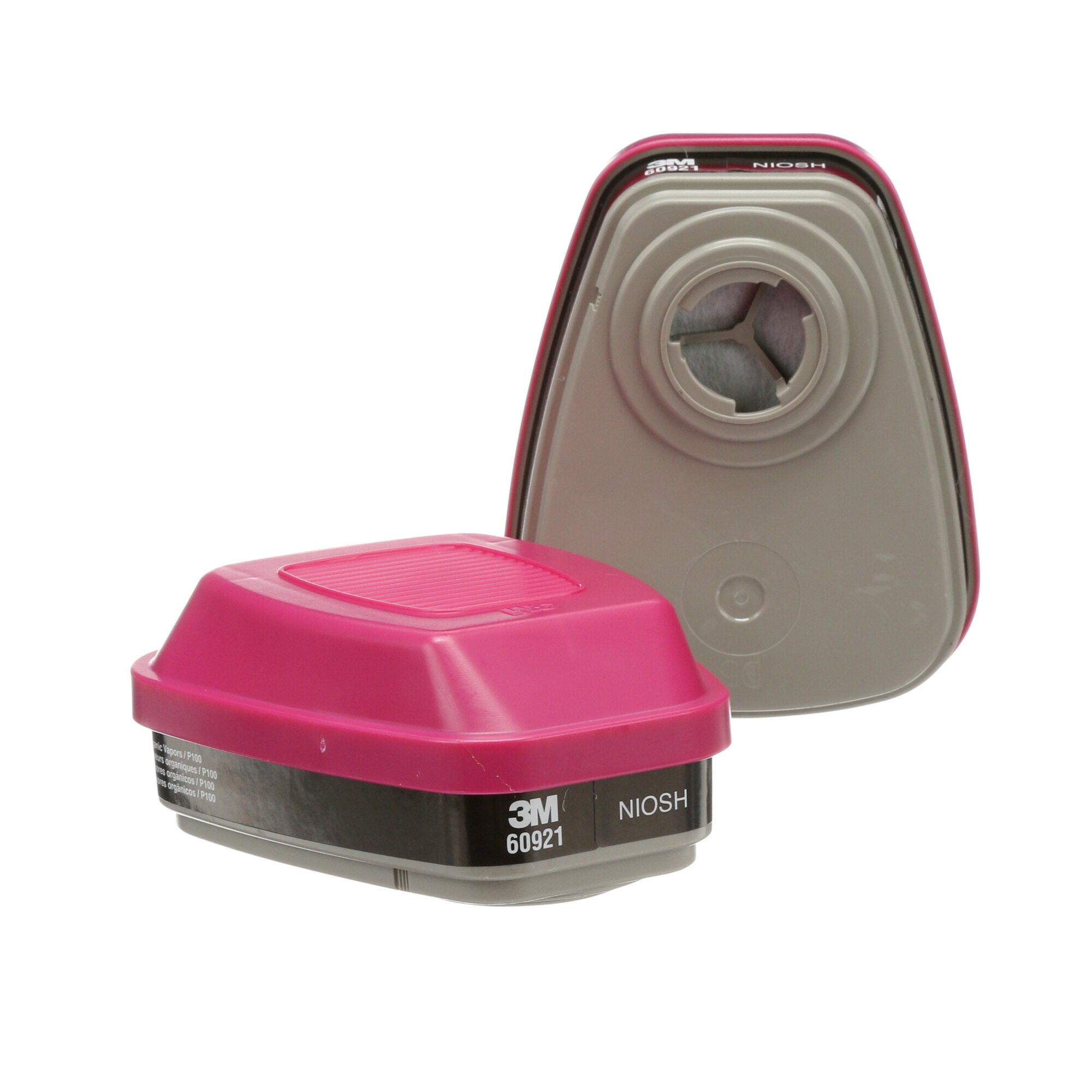
The 3M 60921 combines an organic vapor cartridge with an integrated P100 particulate filter.
This provides two types of protection within a single combination cartridge:
- Protection against certain organic vapors
- P100 filtration against specified oil and non-oil particulates
P100 filters provide at least 99.97% filtration efficiency against the applicable NIOSH test aerosol.
The P classification is oil-proof within applicable manufacturer time-use restrictions.
Why Does the P100 Filter Matter?
Many work processes can produce a combination of airborne particles and vapors.
Examples include certain coating, finishing and maintenance operations, depending on the actual materials and exposure conditions.
A P100 filter can address an approved particulate hazard while the organic vapor cartridge addresses approved vapors.
This makes the 60921 worth considering when both types of protection are required and its approval covers the identified contaminants.
Is the 60921 Better Than the 6001?
Not automatically.
The 60921 adds P100 particulate filtration, which the 6001 does not include.
But if particulate protection is not required, the integrated P100 filter may not provide a meaningful advantage for that application.
More features do not necessarily mean a better respirator configuration.
Who Should Consider the 60921?
- Workers requiring protection against certain organic vapors and particulates
- Users who prefer an integrated combination cartridge/filter
- Applications requiring P100 particulate efficiency in addition to an approved organic vapor cartridge
- Buyers comparing combination cartridges rather than assembling separate prefilters and retainers
Shop: 3M 60921 Organic Vapor/P100 Cartridge at EIO.
3. 3M 60923: Organic Vapor/Acid Gas/P100 Cartridge

The 3M 60923 combines three capabilities:
- Protection against certain organic vapors
- Protection against certain specified acid gases
- P100 particulate filtration
It is designed for applications where multiple types of airborne contaminants may be present and the cartridge's specific approvals match those hazards.
Which Acid Gases Does the 60923 Cover?
According to 3M's respirator instructions, the 60923 is approved for certain organic vapors and specified acid gases, including chlorine, hydrogen chloride and sulfur dioxide, or hydrogen sulfide or hydrogen fluoride, subject to the exact approval and use limitations.
This does not mean it protects against every acid gas or every concentration of those substances.
Some contaminants have special restrictions, and a particular gas may require a different respiratory protection approach.
Does the 60923 Replace Every Other Cartridge?
No.
The 60923 has broader listed contaminant categories than the 60921, but it is not a universal gas/vapor cartridge.
For example, ammonia and methylamine require a cartridge approved for those contaminants, such as the 3M 60924 in appropriate approved configurations.
Formaldehyde also requires a cartridge specifically approved for formaldehyde, such as the 3M 60925, subject to its limitations.
Who Should Consider the 60923?
- Users whose assessed exposures include certain organic vapors and specified acid gases
- Applications requiring P100 particulate filtration alongside those gas/vapor protections
- Industrial environments with multiple identified contaminants covered by the 60923 approval
- Buyers who need a combination cartridge specifically selected for organic vapor and acid gas hazards
Shop: 3M 60923 Organic Vapor/Acid Gas/P100 Cartridge at EIO.
4. Three Important Differences Between the 6001, 60921 and 60923
Difference #1: Particulate Filtration
The 6001 is an organic vapor cartridge without an integrated particulate filter.
The 60921 and 60923 include integrated P100 particulate filters.
If the work environment contains airborne particles that require respiratory protection, the presence or absence of particulate filtration becomes an important selection factor.
For a detailed comparison of standalone P100 filters, read our 3M 2091 vs. 2097 vs. 7093 P100 Filter Guide.
Difference #2: Acid Gas Protection
The 6001 and 60921 are organic vapor products.
The 60923 adds protection against certain acid gases specified in its approval.
That difference can be critical when an exposure assessment identifies both organic vapors and acid gases.
Do not choose the 60923 merely because it covers more categories. Choose it when those categories match the actual hazard.
Difference #3: Cartridge Configuration
The 6001 allows certain approved particulate prefilter combinations to be assembled separately.
The 60921 and 60923 integrate P100 filtration into the cartridge/filter assembly.
The integrated designs can simplify component selection when the combination is appropriate, although size, weight, breathing resistance and compatibility with other protective equipment should also be considered.
5. Which Cartridge for Painting, Woodworking, Cleaning and Industrial Work?
 The following examples explain how the differences may matter. They are not substitutes for identifying the actual contaminants and concentrations.
Spray Painting
Spray painting may generate both airborne paint particles and solvent vapors.
When both organic vapor and particulate protection are required, a properly selected combination cartridge/filter such as the 60921 may be considered.
The 60923 may be appropriate only if its additional acid gas approval matches an identified hazard.
Important: Certain spray coatings, especially those involving isocyanates, may require supplied-air respiratory protection or other specific measures. Never assume a 6001, 60921 or 60923 is suitable for every paint or spray process.
Woodworking and Finishing
Woodworking may involve dust from cutting and sanding as well as vapors from stains, finishes, adhesives or cleaning products.
A particulate-only filter may be appropriate for certain dust exposures, while an organic vapor cartridge or combination cartridge may be required for other assessed hazards.
See our Best Respirator for Woodworking Guide.
Solvent-Based Cleaning
Some industrial cleaners and degreasers release organic vapors.
The 6001 or 60921 may be considered when the identified vapor is within the cartridge's approval and use limits.
However, not all cleaning chemicals are organic vapors. Some may contain ammonia, acid gases or other substances requiring different cartridges or protection methods.
Industrial Maintenance
Maintenance work can involve combinations of dust, fumes, vapors and gases.
The 60923 may be worth evaluating when certain approved acid gases are present along with organic vapors or particulates.
But no single cartridge should be assumed suitable for all maintenance operations.
Concrete and Silica Dust
Silica dust is a particulate hazard, not an organic vapor.
A properly selected particulate respirator may be needed, but the organic vapor capabilities of the 6001, 60921 or 60923 are not automatically useful for silica exposure.
OSHA's silica standards may also impose task-specific requirements.
Read our Best Respirator for Silica Dust Guide.
Welding and Metalworking
Welding can generate metal fumes and gases. Grinding may generate particulate material from the workpiece and its coatings.
The appropriate respirator and filter must address the actual contaminants, including any gases that a particulate filter alone cannot remove.
Read our Best Respirator for Welding Guide.
6. Other 3M Cartridges Worth Comparing
The 6001, 60921 and 60923 are only three options in the larger 3M bayonet cartridge family.
Depending on the hazard assessment, another model may be a better match.
| 3M Model | Protection Category | EIO Product |
|---|---|---|
| 6002 | Certain acid gases | Shop 6002 |
| 6003 | Certain organic vapors and acid gases | Shop 6003 |
| 6004 | Ammonia and methylamine | Shop 6004 |
| 6005 | Formaldehyde and certain organic vapors | Shop 6005 |
| 6006 | Certain multiple gases and vapors | Shop 6006 |
| 60922 | Certain acid gases and P100 particulates | Shop 60922 |
| 60924 | Ammonia/methylamine and P100 particulates | Shop 60924 |
| 60925 | Formaldehyde/organic vapor and P100 particulates | Shop 60925 |
| 60926 | Certain multiple gases/vapors and P100 particulates | Shop 60926 |
Each cartridge has its own approved contaminants, restrictions and service-life considerations. Always consult the current manufacturer documentation.
7. Which 3M Respirators Fit the 6001, 60921 and 60923?
 All three use the traditional 3M bayonet connection and are compatible with several approved 3M reusable respirator families.
Common half-facepiece options include:
- 3M 6100 — Small
- 3M 6200 — Medium
- 3M 6300 — Large
- 3M 6501QL — Small
- 3M 6502QL — Medium
- 3M 6503QL — Large
- 3M 7501 — Small
- 3M 7502 — Medium
- 3M 7503 — Large
These cartridges may also be compatible with additional approved 3M full-facepiece models.
Compatibility must be verified against the current NIOSH approval and 3M user instructions for the complete assembly.
Note: Traditional bayonet cartridges do not fit 3M Secure Click respirators, which use a different connection system.
For help comparing facepieces, read our 3M 6000 vs. 6500QL vs. 7500 Respirator Comparison.
8. How Long Do 3M 6001, 60921 and 60923 Cartridges Last?
There is no universal cartridge service life that applies to every user or work environment.
Gas and vapor cartridge service life depends on factors such as:
- Specific airborne chemicals
- Exposure concentrations
- Mixtures of contaminants
- Temperature and humidity
- Breathing rate and workload
- Cartridge capacity
- Duration and frequency of use
- Storage conditions
- Manufacturer instructions
Can You Wait Until You Smell a Chemical?
No. Odor is not a reliable primary method for determining when to replace a gas or vapor cartridge.
Some chemicals have poor warning properties, and a person may not detect hazardous breakthrough before overexposure occurs.
For occupational use, OSHA requires gas/vapor cartridges to have an appropriate end-of-service-life indicator certified for the contaminant or a change schedule based on objective information or data.
Employers should establish a documented replacement schedule rather than relying on smell alone.
What About the P100 Filter?
The 60921 and 60923 also contain particulate filters.
The particulate component may need replacement because of excessive loading, increased breathing resistance, contamination, physical damage or applicable time-use restrictions.
Both the gas/vapor cartridge service life and the particulate filter condition must be considered.
For additional information, consult 3M's Cartridge and Filter Replacement Program.
9. How to Select the Correct Organic Vapor Cartridge
Before choosing a cartridge, answer these questions:
- What contaminants are present? Identify the exact chemicals and airborne particles using product documentation, Safety Data Sheets and exposure assessments.
- What are their airborne concentrations? Cartridge suitability depends on exposure level, not just the name of the chemical.
- Are particulates present? If airborne particles require protection, determine the appropriate particulate filter classification.
- Are acid gases present? If so, verify that the cartridge is specifically approved for each identified gas.
- What respirator is being used? Confirm that the complete facepiece and cartridge combination is approved.
- What is the required protection factor? A half-facepiece air-purifying respirator may not provide sufficient protection for every exposure.
- What is the cartridge change schedule? Establish service life using appropriate objective data and manufacturer guidance.
For occupational applications, respiratory protection should be selected within a compliant workplace program.
Read our OSHA Respiratory Protection Requirements Guide for more information.
10. Frequently Asked Questions
What is the difference between 3M 6001 and 60921?
The 6001 protects against certain organic vapors but does not include an integrated particulate filter. The 60921 combines protection against certain organic vapors with P100 particulate filtration.
What is the difference between 3M 60921 and 60923?
Both include organic vapor protection and P100 particulate filtration. The 60923 additionally provides protection against certain specified acid gases.
Is the 60923 better than the 60921?
Not universally. The 60923 covers additional specified acid gases, but that feature is only useful when those hazards are present and within the cartridge's approved limitations.
Does the 3M 6001 filter dust?
The 6001 does not include an integrated particulate filter. Certain separately approved particulate prefilters may be used with compatible 6000 Series cartridges and retainers.
Does the 3M 60921 protect against dust?
Yes. The 60921 includes a P100 particulate filter, which provides at least 99.97% filtration efficiency against the applicable NIOSH test aerosol.
Does the 3M 60923 protect against acid gases?
Yes, certain specified acid gases within its approval and use limitations. It is not approved for every acid gas or every concentration.
Can the 6001 protect against chlorine gas?
No. The 6001 is an organic vapor cartridge, not an acid gas cartridge. A specifically approved cartridge or other respiratory protection system must be selected for chlorine exposure.
Does the 60921 protect against chlorine?
No. The 60921 provides organic vapor and P100 particulate protection, not acid gas cartridge protection.
Does the 60923 protect against ammonia?
The 60923 is not an ammonia/methylamine cartridge. An appropriate ammonia-approved cartridge, such as the 60924 or another suitable approved option, must be evaluated.
Which cartridge is best for spray painting?
That depends on the coating, solvents, airborne particles, exposure concentrations and application method. Certain operations may require organic vapor plus particulate protection, while others—particularly some isocyanate-containing spray processes—may require supplied-air protection or other specific controls.
Can I use the 60921 for woodworking?
The 60921 may be considered when both certain organic vapors and P100 particulate protection are required. For wood dust alone, an appropriately selected particulate filter may be more suitable.
How often should I replace a 3M 6001 cartridge?
Replacement must follow an appropriate cartridge change schedule based on objective information, or an approved end-of-service-life indicator where applicable. There is no universal number of hours for all chemicals and working conditions.
Can I wash 60921 or 60923 cartridges?
No. Do not wash the gas/vapor cartridge or integrated particulate filter to restore performance. Clean the reusable facepiece separately according to manufacturer instructions.
Do these cartridges fit the 3M 6200?
Yes. The 6001, 60921 and 60923 are compatible with the 3M 6200 in approved configurations.
Do these cartridges fit the 3M 7502?
Yes. The 6001, 60921 and 60923 are compatible with the 3M 7502 in approved configurations.
Do these cartridges fit 3M Secure Click respirators?
No. They use the traditional 3M bayonet connection, while Secure Click respirators use a different cartridge connection system.
Are organic vapor cartridges safe in oxygen-deficient environments?
No. Air-purifying respirators do not supply oxygen and must not be used in oxygen-deficient atmospheres, IDLH atmospheres, unknown atmospheres or other conditions outside their approved limitations.
11. Shop 3M Organic Vapor and Combination Cartridges at EIO
If you need a cartridge for certain organic vapors without integrated particulate filtration, start with the 3M 6001 Organic Vapor Cartridge.
If your assessed hazards require certain organic vapor protection and P100 particulate filtration, consider the 3M 60921 Organic Vapor/P100 Cartridge.
If certain specified acid gases are also present, the 3M 60923 Organic Vapor/Acid Gas/P100 Cartridge may be appropriate after verifying its approval for the exposure.
Need a compatible facepiece? Explore the EIO Reusable Respirator Collection.
Continue Learning About 3M Respiratory Protection
- Complete Guide to 3M Reusable Respirators
- 3M Respirator Filters and Cartridges Explained
- 3M 2091 vs. 2097 vs. 7093 P100 Filters
- 3M 6000 vs. 6500QL vs. 7500 Respirators
- N95 vs. P95 vs. P100 Respirators
- OSHA Respiratory Protection Requirements
Respirator Safety Disclaimer
This article provides general educational information and is not a substitute for a workplace hazard assessment, exposure monitoring, Safety Data Sheets, current manufacturer instructions, NIOSH approval documentation, professional industrial-hygiene advice or an employer's respiratory protection program.
Cartridge and respirator selection must account for the specific contaminant, concentration, exposure limit, required protection factor, work environment, facepiece fit, service life and applicable regulations.
Air-purifying respirators do not supply oxygen and must not be used in oxygen-deficient, immediately dangerous to life or health (IDLH), unknown or otherwise unsuitable atmospheres.
For occupational use, follow applicable OSHA respiratory protection requirements, including medical evaluation, fit testing, training, maintenance, cartridge change schedules and a written respiratory protection program where required.
Always follow current 3M instructions and NIOSH approvals for the complete facepiece, cartridge, filter and accessory configuration.